FREE HOME DELIVERY ON ORDERS OVER £30 • SAME DAY SHIPPING WHEN YOU ORDER BY 12PM
FREE HOME DELIVERY ON ORDERS OVER £30
SAME DAY SHIPPING WHEN YOU ORDER BY 12PM
FREE HOME DELIVERY ON ORDERS OVER £30 • SAME DAY SHIPPING WHEN YOU ORDER BY 12PM
FREE HOME DELIVERY ON ORDERS OVER £30
SAME DAY SHIPPING WHEN YOU ORDER BY 12PM

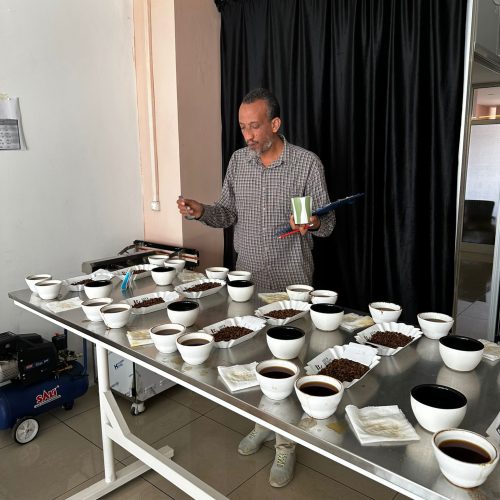
Earlier this year, we travelled to Ethiopia with Algrano, where we had the chance to visit farms, washing stations and drying beds, as well as attend a few workshops at AFCA. One of the highlights was a big cupping featuring coffees from people Algrano works with. One table in particular really stood out to us: Moata Raya’s. We found ourselves going back to his table time and time again, with some of our favourite coffees from the whole trip coming from there.
Unfortunately, Moata wasn’t around on the day, so we never got the chance to meet him. Fast forward a few months and we came across Lunar through Omwani. It was a lovely surprise to discover that this was Moata’s very first coffee processing project, and even more exciting to have the opportunity to try a coffee that he’d produced himself.
It’s a coffee that’s particularly special to us, not just because of the connection to our trip, but because of the impression his coffees left on us in Ethiopia.
We’ve been looking forward to getting this one on the menu and can’t wait to share it with you.
Body
Acidity
Tasting notes
Roast level
For consistent results, we recommend brewing with measured inputs rather than estimating by eye. Always use a digital scale to weigh both your coffee dose and water. As a baseline, use a brew ratio of 60–70g of coffee per litre (1000g) of water. This range can be adjusted depending on the brewing method, water composition, and the specific coffee you’re working with. Control your variables, make small adjustments, and use taste to guide your final recipe.
Consistency in espresso comes from working within the parameters of your equipment. Use the dose recommended for your basket (usually marked on the side or provided by the manufacturer) and keep it consistent. As a starting point, aim for a brew ratio of around 1:2 — for example, 18g of coffee yielding 33–35g of espresso in the cup. Target an extraction time of 22–30 seconds, with a brew water temperature between 93–95°C. From there, adjust grind size to control flow and use taste to fine-tune the result.
For method-specific guidance, you can find all of our brew guides here.
cranberry • peach • bergamot

Meet Mo
Originally, Mo worked with an NGO focused on improving agricultural businesses around the world. As a representative in Ethiopia, he spent time working alongside farmers across the country, providing resources such as agronomy training and better equipment to help improve their businesses.
After 15 years of building relationships with farmers, Mo moved into a consultancy role, connecting producers with potential buyers. This eventually led to the idea of helping farmers navigate the export process, and Mecota Trading was born.
Mo has been instrumental in sourcing our upcoming shipment of Ethiopian coffees. Without his knowledge and connections, Omwani would have struggled to find some of the individual farmer lots they have available today.
The Story Behind Lunar
Lunar is the first coffee Mo has processed himself. The name comes from the nickname of his daughter when she was born, making this a particularly personal project.
For Mo, Lunar represents the beginning of a long-held dream. After many years working in Ethiopian coffee quality, farm management and processing, as well as supporting farmers, he finally decided to take the next step and produce coffee himself.
His work has always centred around improving coffee quality and helping Ethiopian farmers produce and market traceable, high-quality coffees.
Mo shared his idea with some friends, and one kindly offered him the opportunity to use his family’s farm in Chewa village, Gomma district, near Agaro. The area is well known for the coffees produced by the Duromina cooperative.
How was the coffee processed?
To get the project started, Mo purchased a small two-disc coffee pulper and trained his friend’s parents in producing honey-processed coffee. They carefully managed the process from harvesting through to drying.
For this first batch, ripe red cherries were hand-picked from the family farm and pulped around eight hours after harvesting.
Only a small amount of water was used during pulping, approximately 5% of the amount of mucilage removed. This helped the cherries move smoothly through the discs while removing some of the mucilage.
After pulping, the parchment was moved onto raised drying beds in the evening. During the day, the coffee was spread evenly and turned every two hours to encourage uniform drying.
On particularly hot days, shade nets were used to protect the coffee from excessive heat while maintaining good airflow. There was no permanent overhead shade.
The coffee took approximately 10–12 days to dry.
|
🎄 Home brewers, Black Friday is on! Enjoy 25% off selected espressos until 30/11. 🎄
|
Always the best choice. Grind at home for maximum freshness and full control over your coffee.
Our coarsest grind. Ideal for Cafetiere, Chemex, Cold Brew, and Batch Brew.
Works well for cone brewers like V60, and flat-bottom brewers like Kalita or other pour-over brewers.
A finer grind suited to Moka pots, AeroPress, and most domestic espresso machines with pressurised baskets.
Very fine and intended for commercial espresso machines. For best results, grinding fresh is recommended.